
Missouri Corrections Release Paths
No Missouri Department of Corrections adult prison was identified in Schuyler County. A person sentenced to state prison from a Schuyler County case can be placed at any institution the department assigns. Search by the individual, not by trying to find a local state prison. The statewide record may show institutional custody, a field assignment after release, or a completed sentence in historical data.
Leaving a prison can lead to parole, conditional release, or discharge. Parole follows a Missouri Parole Board order. Conditional release is the supervised part of an eligible sentence after the prison portion. Both can place a person in the community while MODOC retains legal custody. Discharge is later and indicates that the pertinent department sentence or supervision event ended. None of these terms alone rules out a different case or another agency’s custody.
| State record status | What it supports | Next confirmation |
|---|---|---|
| Institution assignment | Current placement in the state prison system | Institutional caseworker |
| Probation | Court-ordered community supervision | Assigned field officer and judgment |
| Parole | Community release under Board authority | Field officer and parole event |
| Conditional release | Supervised conditional portion of a sentence | Field officer and sentence dates |
| Discharge or completed flag | End of the listed MODOC obligation | Historical event and court record |
Confirm a Missouri Corrections Release
The MODOC Offender Search is the starting point for an active offender. It includes people held in institutions and people supervised on probation or parole. It does not provide discharged-offender history. The form is CAPTCHA-gated, shows a current-as-of or nightly timestamp, and may omit some active records for safety, security, or confidentiality.
Use a careful sequence. A same-name hit is not enough, and a missing result does not prove release.
- Enter the correctly spelled name and use a DOC number when known.
- Match the result with identifying details, the Schuyler County cause number, sentencing county, or date of birth where available.
- Read the assigned place and whether the record points to an institution or field supervision.
- Quote each release-date label exactly. Do not turn every date into a projected release date.
- Ask the institutional caseworker or assigned probation and parole officer to clarify a case-specific status.
- Use historical Sunshine data and the court record if the active search returns no discharged record.
The full Schuyler County search and release-record sequence also explains how the sheriff, court, and state systems fit together on the Schuyler County released inmates search.
Active Versus Discharged MODOC Records
The public interactive search states that it searches active offenders. That group includes people in prison and people outside prison on probation or parole. It is well suited to a prison release that is followed by supervision. It is not a historical archive of everyone discharged from MODOC. An absent person may be discharged, withheld from the public view, entered under different identity data, or outside the department’s population.
For older history, MODOC’s Sunshine Law page links a nightly downloadable database covering people who are or have been supervised, with records extending as early as 1974. The department warns that the extract may be incomplete, inaccurate, or not current. It can contain several rows for one person or charge. A completed flag marked “Y” supports sentence completion, but it should be reconciled with the event history, the filed judgment, and a direct department response.
The distinction matters in Schuyler County because the local jail record and the statewide corrections record cover different custody stages. A sheriff release sheet may show delivery to MODOC, which is a transfer rather than community release. Later, an active MODOC result may show that the same person moved from an institution to a field assignment on parole or conditional release. Once final discharge removes the person from the active population, the Sunshine extract, the Schuyler County court case, and a direct records response form the historical chain. Check the lifetime DOC ID and cause number across those sources. Dates may post on different schedules, so use the actual state event to confirm release and the completed field to support later sentence completion.
Missouri Corrections Record Fields
The Sunshine layout gives Schuyler County researchers a richer historical path than the active interface alone. Each field answers a narrow question. Read rows as parts of a record, not as a ready-made narrative.
| Official field | How to use it |
|---|---|
| Lifetime DOC ID | Helps match the same person across MODOC rows |
| Assigned place | Identifies the listed institution or field placement |
| Field/institution flag | Separates community assignment from institutional placement |
| Cause number | Connects the sentence row to the Missouri court case |
| Offense and sentencing county | Helps isolate a Schuyler County sentence |
| Completed flag | Supports completion of the listed sentence record |
| Sentence date and length | Shows the recorded sentence basis |
| Probation date and term | Describes a recorded probation period |
The same data documentation uses precise release fields. “Sentence-I Minimum Release Date” is the department’s calculated minimum release date on an active sentence. “Sentence Maximum Release Date” is the expiration date. Codes such as 99999999 for life, 88888888 for indeterminate or interstate circumstances, and 66666666 for certain court-ordered assessment or investigation cases are sentinel values, not calendar dates.
MODOC Release Date Meanings
A future minimum date is a calculation, not an actual release event. It can change after a corrected sentence, an amended judgment, treatment of concurrent or consecutive terms, jail credit, Parole Board action, revocation, a new conviction, program requirements, or lawful loss and restoration of credit. MODOC also explains that statutory conditional release applies to non-life terms and that required program completion can affect some release dates.
Missouri law divides eligible term-of-years sentences into prison and conditional-release portions. Conditional release is a conditional discharge into supervision, not the end of the sentence. Good-time credit for an eligible prisoner depends on department policy, conduct, program use, exclusions, and official action. It is not safe to estimate a date by subtracting a fixed number of days each month.
The often-used 85 percent phrase applies to the dangerous-felony rules in Missouri law, not to every felony. Other statutory minimums and offense-specific limits may apply. Start with the judgment, offense, sentence structure, credited custody time, and current law. Then treat the displayed date as calculated until an actual event posts.
County jail terms are different. A Schuyler County jail-credit calculation comes from the sheriff and sentencing court. A state prison formula should not be copied onto a county sentence.
View the MODOC Release Search
The official Missouri offender search form is the public entry point for an active state record.
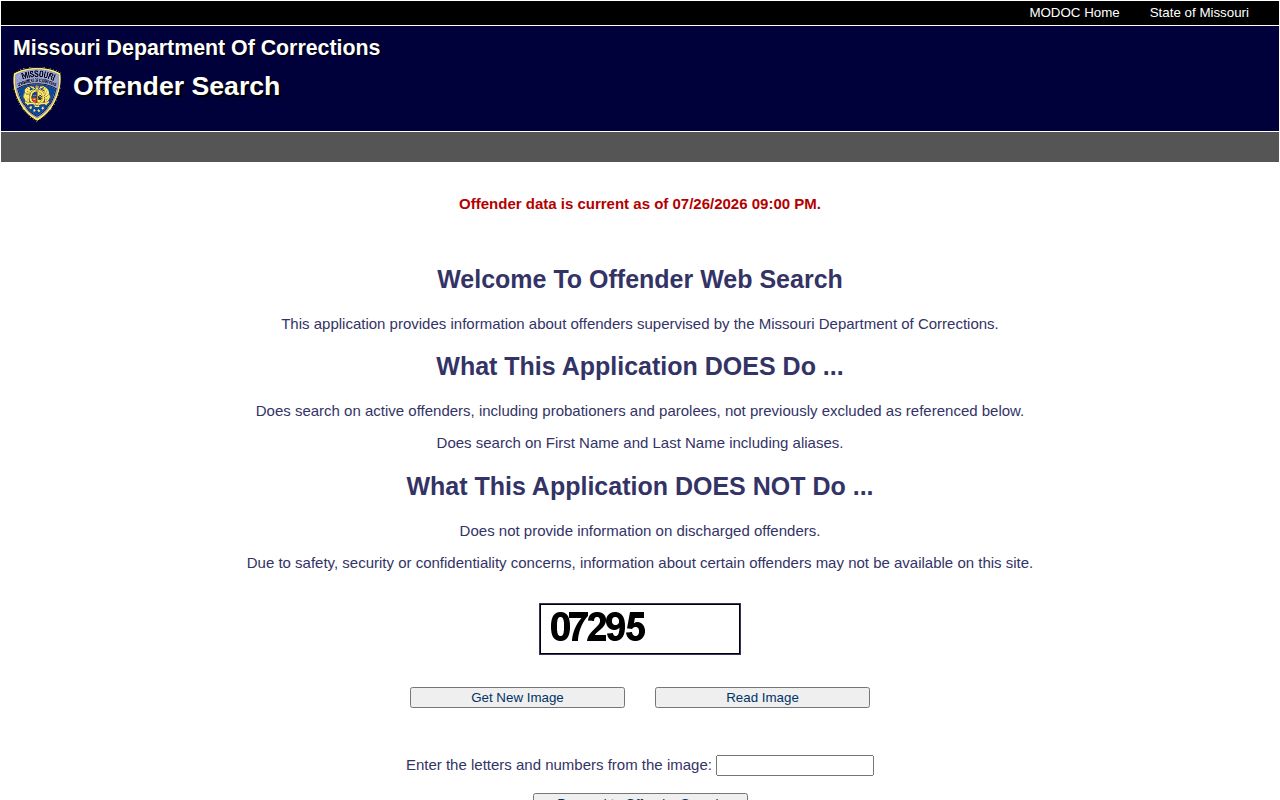
The form begins the identity check. The result’s assignment, status, exact date labels, court cause number, and update time supply the context needed to interpret it.
Missouri Corrections Release Records
When an online result is unclear, use MODOC Constituent Services for general search help. The department asks for the full name and, when available, the inmate number and date of birth. Its contact page says general email search assistance usually receives a response within 24 hours during regular business hours. That statement is not the deadline for producing a Sunshine request.
Missouri Department of CorrectionsOffender Search and Constituent Services
Online contact and inquiry route
Case-specific questions: institutional caseworker or assigned field officer
Historical public records: MODOC Sunshine Law process
Missouri’s Sunshine Law sets the public-record process. Section 610.023 addresses the records custodian and response handling, while section 610.026 governs allowable copy, staff, research, and media charges. Ask for a narrow offender event or sentence record, include the identity details and date range, and request electronic delivery when practical. Protected medical, treatment, personal, and security information can remain closed.
Missouri Parole Release Decisions
The Missouri Parole Board sits within MODOC. Its official rules, known as the Blue Book, provide the hearing schedule framework and time-to-serve appendices. Guidelines do not promise release. The Board may set a date above or below them, deny parole, extend conditional release after required process, or schedule another hearing.
No public person-by-person hearing calendar or searchable decisions database was located. Missouri law permits parole meetings, records, and votes to be closed. The public process says a hearing may result in a future release date or another hearing in one to five years, and decisions commonly take about eight to twelve weeks. A hearing itself does not establish that the person left prison.
- Parole
- Community release by Board order while the person remains in MODOC legal custody.
- Conditional release
- The supervised portion of an eligible sentence after the prison portion.
- Probation
- Community supervision ordered by a court, rather than release on a prison parole order.
- Discharge
- The end of the pertinent MODOC sentence or supervision event.
For a Schuyler County person under field supervision, MODOC must confirm the assigned office and officer. District 3 serves Schuyler, but the nearest office should never be assumed to be the individual reporting location.
Public Record Search
Sponsored Results