
Federal BOP Release Outcomes
The Federal Bureau of Prisons is the prison custodian for sentenced federal prisoners. It is not the Schuyler County Jail, and no BOP institution was identified in Schuyler County. A person whose case began in or near Schuyler County may be sentenced in federal court and housed wherever BOP assigns that person. The county sheriff’s local release sheet cannot establish the later BOP release date. The federal record must do that work.
A BOP result marked “Released” means the person is no longer in BOP custody. That statement has a narrow scope. The person may have returned to the community, entered federal supervised release, moved into another justice system, or passed to another agency. Supervised release is a court-ordered period in the community after imprisonment. It is not BOP confinement, yet it can carry active terms and federal court oversight. A federal release record should therefore be read as an exit from one custodian, not as proof that all legal control ended.
- BOP release
- An exit from Federal Bureau of Prisons custody.
- Supervised release
- A federal court term served in the community after prison.
- Transfer
- A move from one custodian to another without community freedom.
- Discharge
- The end of the specific sentence or supervision event being checked.
Confirm a Federal BOP Release
The official BOP Inmate Locator is the first search for a sentenced federal prisoner. It covers federal inmates from 1982 forward. Search either by a known federal register number or by exact name. A name search can also use age, race, and sex to narrow results. Those extra fields help reject a person with a similar name, but the full record still must be compared with known case facts.
- Choose the number search when a federal register number is known. It is more precise than a name alone.
- Otherwise enter the exact first and last name, then use the optional identity fields to narrow the match.
- Open the result and compare the name, register number, age, race, and sex with reliable case information.
- Read the location or status together with the displayed release date. Do not treat either field by itself as the whole custody history.
- Check the federal docket or supervising authority when the next legal status matters.
The broader Schuyler County search and local release-record path is covered on the Schuyler County released inmates search. That local path should be used first unless a court entry, transfer record, federal register number, or known agency involvement points to BOP.
The official federal locator screen shows the search choices used for a BOP release check.
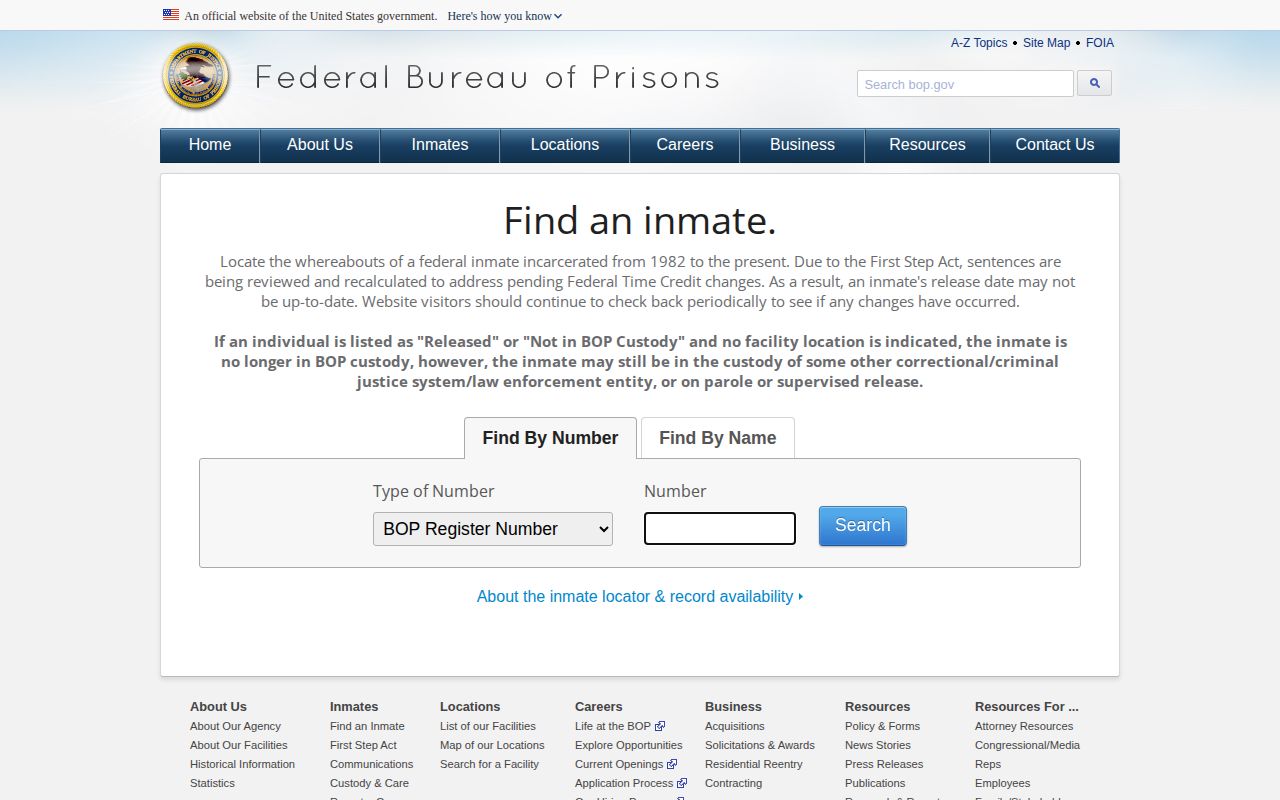
The locator is useful for federal prison status, while Schuyler County sheriff and court records remain separate sources for a local arrest or county custody event.
Federal BOP Release Record Fields
A matching BOP locator result presents a compact set of identity and custody fields. Each field answers only part of the question. The register number is the strongest locator key. The release date supplies timing, while the location or status identifies the Bureau’s current record state. A past date and “Released” status support an exit from BOP on that date. They do not identify every later custodian or state that federal supervision ended.
| Locator field | What it supports | Limit |
|---|---|---|
| Name | Identity comparison | Names can match more than one person |
| Register number | Specific federal prisoner record | Does not explain the court case |
| Age, race, and sex | Additional match checks | Still compare known case facts |
| Release date | Past BOP exit or future projected date | A future date can change |
| Location or status | Current BOP record state | Does not rule out other custody |
Identity should be matched with more than a name. Then distinguish a federal release from a transfer or supervised release, and compare the custody result with the current official federal court disposition. That sequence avoids turning one locator line into a claim it cannot support.
Note: BOP says locator information updates daily, so a very recent movement may not appear at the moment another agency reports it.
Federal BOP Projected Release Dates
A future date in the locator is projected. It is not proof that the prison door opened on that date, and it should not be described as an actual release before the event occurs. Sentence-credit recalculations can change the projection. A later court action or another lawful custody event can also affect what follows. The sound approach is to save the date as a forecast, then return to the BOP record after the expected event and check for a past date with released status.
A past release date has stronger value, yet scope still matters. BOP confirms its own custody. Federal supervised release is a separate status outside BOP prison confinement, and the locator does not confirm when that supervision ends. State or local custody may also begin after BOP ends. If the person had an unrelated Missouri matter, the BOP result does not clear that matter. A Schuyler County record likewise cannot be used to infer the outcome of the federal sentence.
BOP Release Versus USMS Custody
The U.S. Marshals Service handles federal pretrial prisoner processing and often relies on contract detention facilities. A person can therefore be in federal pretrial custody without appearing as a sentenced BOP prisoner in the way a reader expects. The USMS prisoner information explains that federal pretrial role. USMS does not provide a public released-prisoner name locator equivalent to BOP.
When the case is still pretrial, begin with the federal docket, the actual holding facility, and the agency named in a transport or commitment record. Use BOP after sentencing when the person enters the Bureau system. This distinction is important in Schuyler County because a local jail exit to USMS is a transfer. The sheriff stopped holding the person, but the person did not necessarily enter the community.
The PACER Case Locator can identify the federal case and docket. PACER may require an account and fees. Docket entries may explain an order, sentence, commitment, or supervision term, but the docket is not a substitute for an agency’s physical custody record. The holding facility establishes confinement. BOP establishes Bureau status. USMS records may document the pretrial chain.
Older Federal BOP Release Records
The public BOP locator begins with 1982 records. A person whose federal custody ended before that point requires an archive route instead of a forced locator conclusion. The National Archives is the federal path identified by BOP for older inmate information. Lack of a BOP locator result for an older case does not prove that federal imprisonment never occurred.
For additional Bureau records, use the BOP Freedom of Information Act route. Request an existing record and identify the person, approximate custody dates, institution if known, register number, and the exact record sought. Federal identity and privacy procedures may require DOJ identity certification or limit disclosure. FOIA can reach existing agency records, but it does not compel an agency to create a new custody analysis or answer a list of factual questions.
Federal Bureau of Prisons Records
Locator: BOP Inmate Locator
Coverage: 1982 to present
Older records: National Archives
Additional records: BOP FOIA and applicable identity certification
A narrow request might seek the record reflecting the BOP release date, release status, or institution history. Ask for a date range and a specific record type. If the issue is a pretrial USMS movement rather than a sentenced BOP release, address the request to the agency that likely created the transport or custody record. Federal exemptions and procedures differ from Missouri’s Sunshine Law, so a county records request should not be sent as though it governs BOP.
Note: A no-result search has different meanings for pre-1982 imprisonment, federal pretrial custody, spelling differences, and a person never committed to BOP.
Schuyler Federal Release Records
No federal prison was identified in Schuyler County. That negative finding is carefully limited. It does not mean a Schuyler County defendant cannot enter federal custody, and it does not mean federal officers could never receive someone from the county jail. It means the Federal Bureau of Prisons page represents a nationwide system, not a local building or a confirmed Schuyler County contract site.
If the Schuyler County Jail record lists a federal destination, treat the county event as a transfer until the receiving agency’s record shows otherwise. First obtain the sheriff’s custody event, actual exit date and time, and destination when open. Next identify whether USMS, BOP, or another federal agency became custodian. Then use the source that matches that stage. PACER explains the federal case, USMS may document pretrial handling, and BOP covers a sentenced federal prisoner from 1982 forward.
Do not infer federal custody because a name disappears from a local roster or cannot be found in Missouri corrections. Schuyler County does not publish an official online release archive, and a missing local result carries no destination. The federal search should begin only with case facts such as a federal docket, agency name, register number, commitment, or recorded transfer. Confirm release from each custodian in turn.